
Downtown aglow tonight

Downtown aglow tonight
Half the moon and wee Jupiter hanging bright in the sky last night. How it looked on the Sky Guide app (highly recommended) versus the best my iPhone could do.

Baylor Humanities Prof Alan Jacobs:
Students today … have grown up in a media environment in which, as far as I can see, language is almost exclusively used for three purposes: to praise cultural friends, to condemn or mock cultural enemies, and to declare the Truth. The idea that language might be used to explore a way of seeing the world without judging that way — without issuing a thumbs-up or thumbs-down emoji — is pretty foreign to most of them, especially since most of the literature they’ve been assigned in school is either intrinsically didactic or is taught to them didactically.
Directed by Fritz Lang, 1931
 Had somehow never seen this film. I knew it was about a serial killer of children, and that it was German. I had forgotten it was made in 1931 as the Nazis were coming to power. It doesn’t deal with Nazis, but apparently the Nazis had the power to stop it from being made before being convinced by Lang of the content of the story.
Not surprising that it regularly appears on the best films of all time lists. Working on the edge of filmmaking technology in sound, lighting, editing, and camera work, the movie is still so impressive and also remains a remarkable document of the era.
After establishing that the story is about the hunt for a killer of children, the movie spends most of the second act observing how the police’s obsessive search terrorizes the citizens of Berlin both by failing to find their man and by intruding on every aspect of public life. The criminal class decides that they must make it their business to find the killer to get the police to back off the constant surveillance and raids. Loved the scene that cut back and forth between the city leaders and the criminal bosses holding simultaneous strategy sessions in extremely smoked-filled rooms.
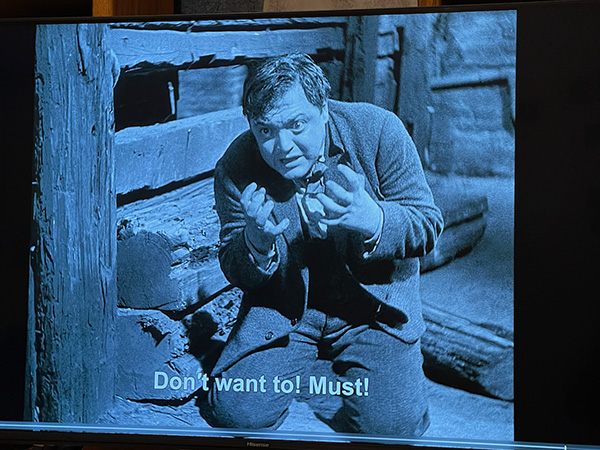
The ending was even more surprising. Instead of simply killing murderer once he is caught, the criminals and poor of the city hold an impromptu trial, complete with a defense attorney, to legitimize their execution of him. Although Lorre’s character insists that he cannot help himself, they argue that the reason they must kill him is because he will use the insanity plea to escape punishment and kill again.


Currently reading: Everything Sad Is Untrue: (A True Story) by Daniel Nayeri 📚
Page 59: Every story is the sound of a storyteller begging to stay alive.
Page 80: This is not a happy lesson. But you either get the truth, or you get good news—you don’t often get both.
Page 92: Memories are tricky things. They can fade or fester. You have to seal them up tight like pickles and keep out impurities like how hurt you feel when you open them. Or they’ll ferment and poison your brain.
Page 122: Does writing poetry make you brave? It is a good question to ask. I think making anything is a brave thing to do. Not like fighting brave, obviously. But a kind that looks at a horrible situation and doesn’t crumble. Making anything assumes there’s a world worth making it for. That you’ll have someplace … to hide it when people come to take it away. I guess I’m saying making something is a hopeful thing to do. And being hopeful in a world of pain is either brave or crazy.
Page 258: “O wise and merciful Mrs. Miller, every story is nestled somewhere within another story.”
Just the moon last night
